


Lash Extension Tweezers Guide 2026: Shapes, Angles, and How to Choose

Quick Answer: Straight tweezers isolate, boot tweezers grip volume fans, angled tweezers work in corners, curved tweezers wrap mega volume. Choose fiber tip for grip, light weight for hand comfort, and matched tension so tips close with zero gap. Beginners start with straight plus boot, then add curved.
Table of Contents
- What lash tweezers actually do
- Straight tweezers for isolation
- Boot tweezers for volume fans
- Angled tweezers for corners and direction
- Curved tweezers for mega volume
- Fiber tip vs standard tip
- How to hold and test tension
- Cleaning and storage
- Which pair to buy first
- Frequently Asked Questions
What lash tweezers actually do
Lash tweezers place one extension or one fan on one natural lash without touching neighbors. Isolation keeps lashes healthy. Fan control keeps sets even. Tip alignment decides both. When tips meet with zero gap at the exact contact point, lashes do not slip or twist. When tips gap, fans collapse and isolation takes twice as long.
Weight matters as much as shape. A heavy pair tires the hand by client three. A balanced light pair keeps the wrist neutral through classic, volume, and mega volume. Finish matters too. Smooth satin steel glides without sticking to adhesive. Fiber tip texture grips the lash base without extra pressure.
- Isolation: separate one natural lash, hold while the other hand places.
- Pickup: lift extensions from the strip without bending or scattering.
- Fan making: grip, bloom, and place narrow or wide fans with even bases.
- Direction: set the extension angle so the set looks uniform from all sides.
Straight tweezers for isolation

Straight tweezers like the Fiber Tip Saturn Straight are the isolation standard. Long straight arms reach under layers without blocking the view. Use the very tip, not the middle, for single lash separation. Hold at 45 degrees to the lash line, not flat, so the tip slides between lashes instead of pushing them.
Straight pairs also place classic extensions well. Pick up from the strip middle, dip a third of the base in adhesive, then slide onto the isolated lash from above. Keep the hand resting on the forehead support for stability. If lashes stick to the tip, clean with adhesive remover, not water alone.
Boot tweezers for volume fans
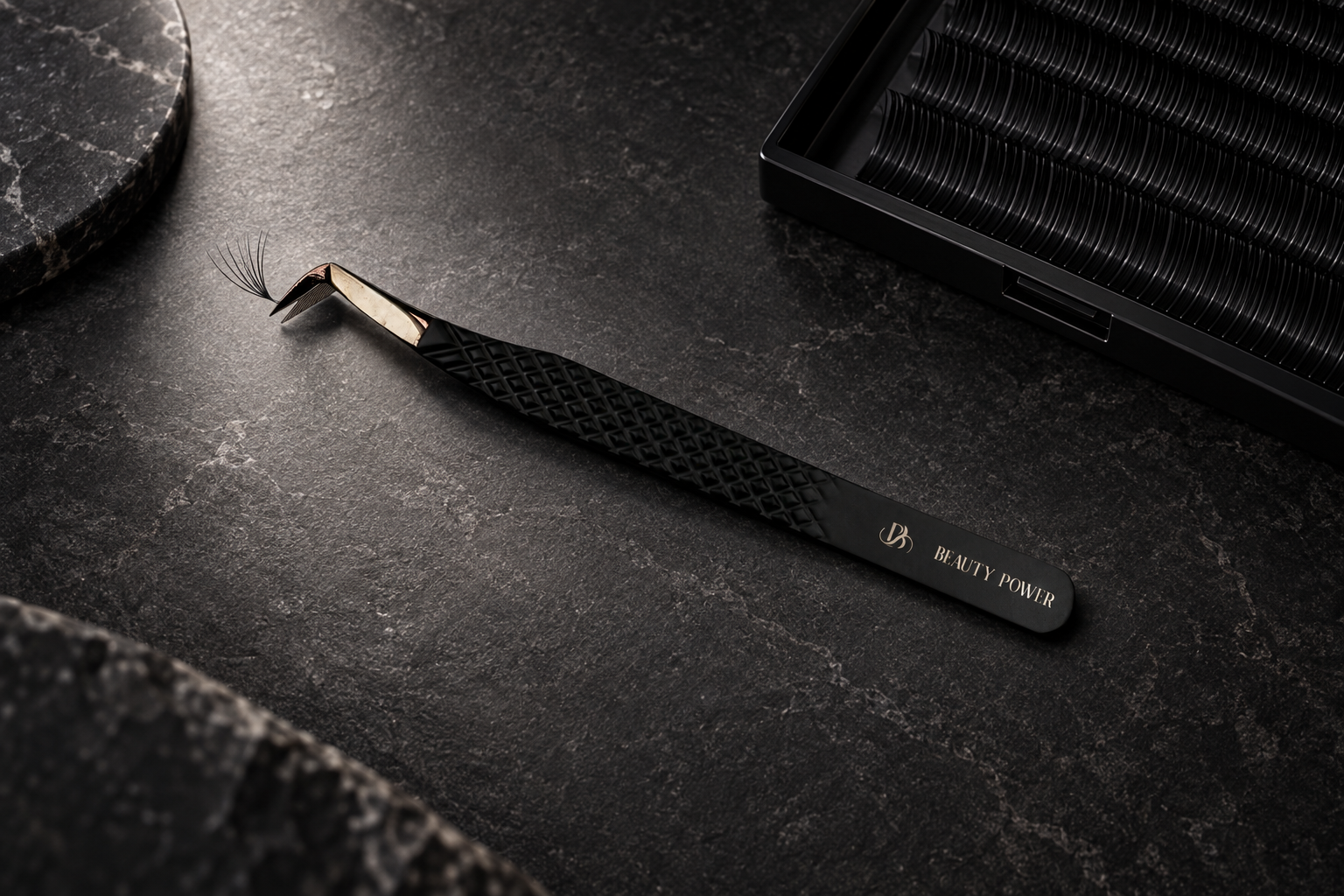
Boot tweezers like the Fiber Tip Neptune Boot grip fans across a wide flat foot. That surface holds the base together while the top blooms. Use for 2D to 6D volume. Grip one third up from the base, bloom with a wiggle or pinch, then dip and place. Do not grip at the very bottom. Bases need room to narrow.
Test the sweet spot before a full set. Grip a fan, lift, turn slightly. If the fan stays even, mark that grip point with muscle memory. If one side drops, move grip slightly higher. Boot tension should feel firm but not stiff. Fingers should not ache after ten fans.
Angled tweezers for corners and direction
Angled shapes like the Fiber Tip Mercury Angled and Fiber Tip Mars Angled reach inner and outer corners without twisting the wrist. The angle keeps the hand out of the sight line. Use for direction correction, inner corner classics, and narrow fans on downward growing lashes.
Pair an angled tweezer with straight isolation for speed. Straight isolates, angled places. Many artists work faster with two different shapes than with two identical pairs because each hand keeps one job.
Curved tweezers for mega volume

Curved tweezers like the Fiber Tip Jupiter Curved wrap around wide fans without crushing the top. The curve follows the fan shape. Use for 7D and up, or for very fine 0.03 lashes that scatter under flat feet. Grip slightly higher than with boot, bloom slow, then place with the curve facing the lash line.
Curved pairs also help with layers. Slide under the top layer, lift gently, isolate below without disturbing placed fans. Keep adhesive dips shallow with mega volume. Wide bases plus deep dips create heavy feet that close fans.
Fiber tip vs standard tip
- Grip: fiber tip texture holds the lash with less pressure, fewer dropped fans.
- Speed: less regrip means faster full sets and less adhesive waste.
- Hand fatigue: lighter pressure keeps fingers relaxed through long fills.
- Cleaning: wipe with lint free pads and remover after each client, then disinfect per local rules.
The Mercury plus Earth Set pairs two complementary fiber tip shapes in one box. It covers isolation plus volume for beginners without buying five singles. Add Volume Trays and Classic Trays to practice both pickup styles.
How to hold and test tension
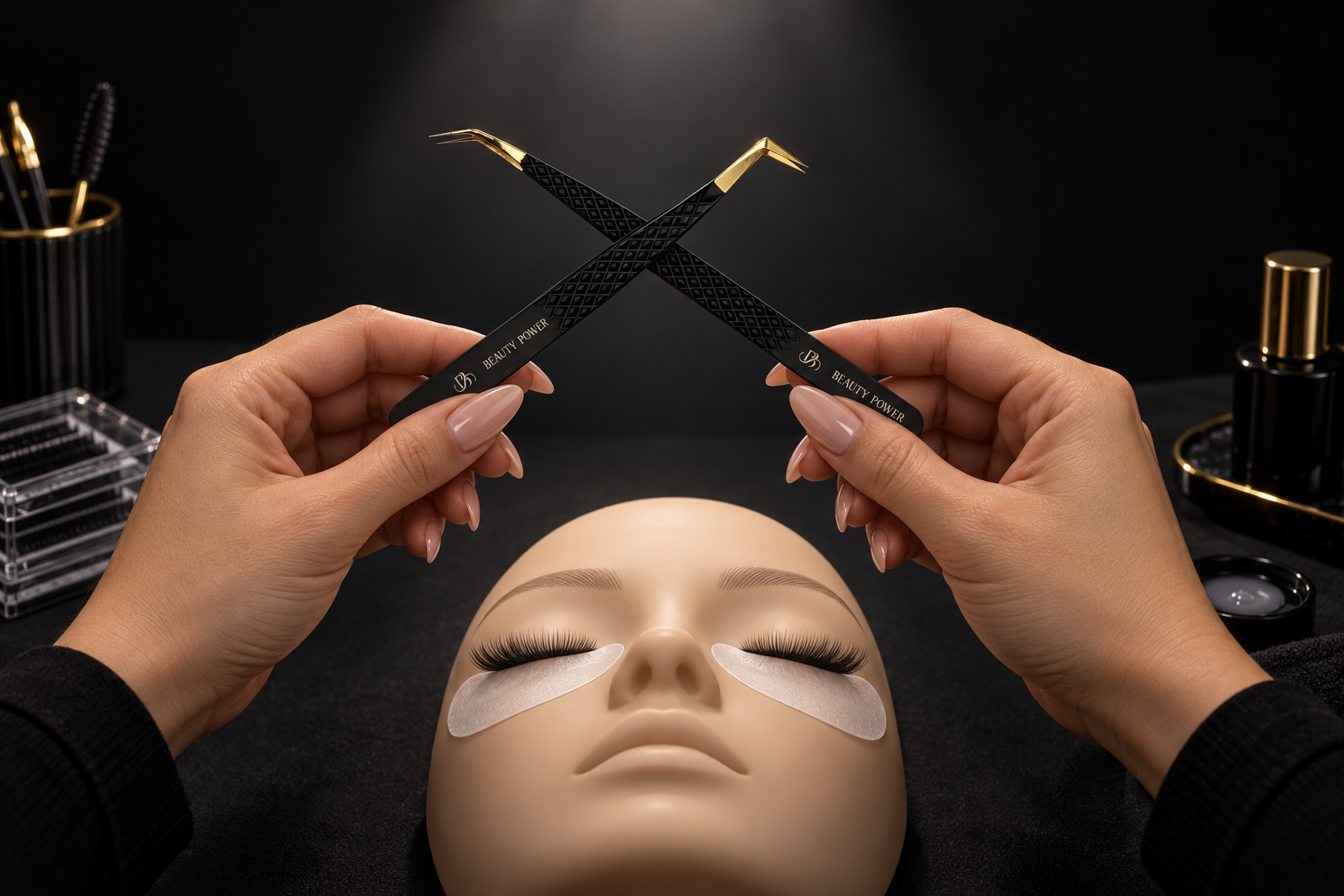
Hold like a pen, thumb and middle finger on the grips, index finger resting light on top. Grip in the middle of the arms, not near the tip. Near tip grip kills spring control. Far back grip loses precision. The sweet spot sits about halfway down.
Test before buying or starting a set. Close tips on a single 0.07 lash and lift. The lash should stay without sliding. Close on tissue edge. Tips should meet evenly, no overlap, no side gap. Tap the arms. They should spring back fast, not slow. Slow spring means hand strain by hour two.
Cleaning and storage
Remove adhesive after each client with remover on lint free pads. Never scrape tips against each other. Disinfect per state rules, dry fully, then store tip down in a case or magnetic holder. Dropped tweezers lose alignment even without visible bends. Test on a single lash after any drop. If grip slips, replace the pair for client work and keep the dropped one for practice.
Which pair to buy first
- Classic only: straight Saturn plus angled Mercury.
- Volume starter: straight Saturn plus boot Neptune.
- Mega volume: add curved Jupiter third.
- Best value: Mercury plus Earth set, then add Saturn.
Browse all lash tools and the Holiday Gift Guide hub for gifting sets.
Frequently Asked Questions
Which tweezer shape is best for beginners?
Straight for isolation plus boot for fans. This pair covers classic and volume basics.
What is the difference between boot and curved?
Boot has a flat wide foot for standard volume. Curved follows wide mega fans without crushing tops.
Are fiber tip tweezers better?
Yes for grip. Texture holds lashes with less pressure, so fans drop less and hands tire slower.
How do I stop fans from closing on pickup?
Grip one third up from the base, keep dips shallow, and avoid squeezing the very bottom.
Can one tweezer do isolation and volume?
Angled pairs can do both in a pinch, but two dedicated shapes work faster and cleaner.
How often should I replace lash tweezers?
When tips gap, grip slips after cleaning, or the spring feels slow. Daily artists often refresh yearly.
How do I clean fiber tip tweezers?
Wipe with remover on lint free pads after each client, disinfect per local rules, dry fully, store tip down.
What lash thickness pairs with these tweezers?
Classic 0.15, volume 0.05 to 0.07, mega 0.03. Match thickness to technique, not to tweezer brand.
Continue Your Beauty Routine
Shop Saturn Straight, Neptune Boot, Jupiter Curved, or browse all lash tools.
Related Reading:
Korean Skincare Gift Ideas 2026
Viktoryia Tsishko is a licensed esthetician with 17 years of professional experience and the founder of Beauty Power. She has trained 30,000+ beauty professionals worldwide and developed Beauty Power's full line of professional-grade tools used by 1,000,000+ customers. Her tools earned the Allure Best of Beauty 2025 Award.